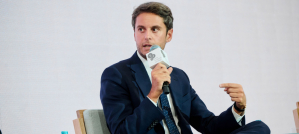

Victor Pinchuk Foundation and YES hosted a discussion ‘Who Can Make Russia Negotiate Seriously?’ during the YES Special Gathering on February 24, 2026
On 24 February 2026, the Victor Pinchuk Foundation and Yalta European Strategy (YES) held a discussion ‘Who Can Make Russia Negotiate Seriously?’ during the YES gathering on the occasion of the fourth anniversary of Russia’s full-scale invasion of Ukraine.
The event brought together leading political figures, government officials, military commanders, experts and parliamentarians from Ukraine, UK, Europe and the USA for a frank and strategic discussion on the state of the war in Ukraine, prospects for its conclusion, and Ukraine’s place in Europe’s future security architecture.
The discussion asked tough questions about how the war will be ended and what options were on the table.
Boris Johnson, Prime Minister of the UK (2019-2022), argued that Europe and the West are not doing enough to ensure a decisive Ukrainian victory. He called for increased military aid, tougher sanctions, and a more resolute stance, including putting European boots on the ground for non-combat roles, to show Putin the West's unwavering commitment to Ukraine's sovereignty and its future within the Western alliance.
Boris Johnson addressed the audience: “Wake up. Look at the reality. The United States supplies 70% of NATO's budget, 95% of NATO's heavy-lift capacity, 95%. Depending on whether you believe that the French ‘force de frappe’ actually works or not, the United States of America supplies 100% of Europe's nuclear deterrent, so we are technologically dependent upon the United States.”
“We're a long day's march from thinking that we can just abandon the United States and can do it on our own. We must not try to sell that vision to Ukraine; it's a sham, a snare and a delusion.”
Gideon Rachman, Columnist, Financial Times, moderator of the discussion, pointed out that “Germany has massively increased its defence spending. Europe is providing all the military aid and all the financial aid. So it's a bit perverse to be attacking the Europeans when it's America that's cut off the military aid and cut off the financial aid.”
Boris Johnson stressed: “There just isn't enough urgency. There's too much complacency in Europe about this. The mere fact that these generals, and these incredible troops have been able to keep going for four years has bred a kind of apathy”, he added.
“Europe, the West, needs to realise that this thing is not going to end until we give more support.
Don't endlessly concede ground or decide that we're not going to give weapons or take away Ukraine's fundamental right to join whatever international body it chooses. Why are we doing that? It's pathetic. The most important thing of all is to end the war decisively in favour of Ukraine. To show Putin that we in the West are actually committed to the freedom of Ukraine, and the long-term destiny of Ukraine is part of the West.”
Hugo Dixon, Commentator-at-Large, Reuters, said: “We need to flip the switch. The first step is to move the entire account out of Belgium to the EU so that it would be far harder for Moscow, and frankly Washington, to bully the whole of the EU. Some may say that Hungary is going to do a U-turn anyway, but we need to put pressure on Hungary to make its U-turn.”
Chrystia Freeland, Deputy Prime Minister of Canada (2019–2024), Advisor to the President of Ukraine on Economic Development, commented: “The response of the Global South at the G20 Finance Ministers meetings was a huge disappointment to me. Those countries I thought would be sympathetic to a war of imperial aggression, chose to see it as a fight about America. To me that has been a great disappointment and actually a great miscalculation, and it's one of the reasons that I have great doubts about the idea we can live in a multilateral, multi-polar nirvana.”
To conclude the session, Gideon Rachman asked Boris Johnson if he could define victory. “A victory for Ukraine would be a free, sovereign, independent country that could choose its own destiny, because that is what it's fundamentally all about.
The YES Special Gathering on February 24 is a platform for an honest conversation about the price of freedom, the limits of endurance, and shared responsibility for the future of Europe. Four years on from the full-scale invasion, Ukraine remains on the front lines not only of its independence, but also of the security of the entire democratic world.
Photos are available here
Video will be on YouTube www.youtube.com/user/PinchukFoundation
←Back to news list