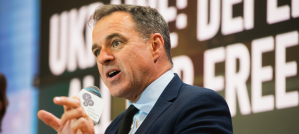

Victor Pinchuk Foundation and YES hosted the 9th Ukrainian Lunch on the margins of the Munich Security Conference
On 14 February 2026, on the occasion of the Munich Security Conference, Yalta European Strategy (YES) and the Victor Pinchuk Foundation hosted the 9th Munich Ukrainian Lunch on the topic ‘Ukraine: Futures’ Frontline’.
The discussion brought together senior politicians, business leaders, and experts to discuss the perspectives for ending Russia’s war against Ukraine, strengthening European security with Ukraine, and integrating Ukraine as a powerful source of security, innovation, and future economic growth into Europe.
Opening the event, Victor Pinchuk, businessman and philanthropist, YES Founder, thanked Ukraine’s partners for support, and at the same time emphasized on their insufficient efforts to ensure Ukraine's victory in this war: “Thank you very much for everything, our European and American friends. But unfortunately, that is not enough. And frankly speaking, four years (of war) in the centre of Europe, in the 21st century is a very long time. You need to understand that in this historic moment you have to be more decisive. You must do more, even if sometimes it seems painful to you.”
Petr Pavel, President of the Czech Republic, admitted that Ukraine’s success requires more support and concrete steps from Europe: “First, we will have to speed up delivery of all necessary military equipment and support to Ukraine, not to lose any more territory and to create a favourable situation on the ground.“
He added that Russia is paying an extremely high cost for waging a war in Ukraine: “Russia insists they hold a strategic initiative, but the cost for every square kilometer of Ukrainian territory is enormously high. It exceeded last month the capacity for recruitment.”
“If we are able to maintain that level of support or increase it, while being very decisive when it comes to strengthening sanctions, especially against Russian shadow fleet, transporting oil from Russia, then we might create favourable conditions for Russia to understand that they can’t achieve more success on the ground and that the only way is to negotiate. I am not sure that Russia is there,” he concluded.
Edgars Rinkēvičs, President of Latvia, also stressed the need to put more pressure on Russia: “We don’t see any signs from Russia to accept any kind of offers on possible peace deals. We can see only diplomatic gaming and rejection.”
“The only way for us to secure peace in 2026 would be by increasing pressure on Russia, most political and economic through sanctions on the shadow fleet and so on, and of course, by supporting Ukraine,” he added.
He also brought up the importance of security guarantees for Ukraine: “We are talking about very solid security guarantees. If we don’t have those, then I very much agree, we are going to have a problem both in Ukraine and in Europe.”
Dick Schoof, Prime Minister of the Netherlands, said: “We have to stay positive and be hopeful. But at the same time, we need to be realistic and strengthen Ukraine, put pressure on Russia all the way we can. And Europe has to play its part in that.”
He also warned against forcing Ukraine into signing a peace deal with Russia on unfavourable terms: “We must prevent this. The only peace that can be reached is a just peace.”
Mette Frederiksen, Prime Minister of Denmark, blamed Russia for being the party failing to agree to peace: “I think that our main problem is that Russia doesn’t want peace. I don’t think that they want peace with Ukraine, and I don’t think that they want peace with Europe. That’s our problem.”
“The only language that Russia understands is power. So if we want peace in Ukraine, we need to give Ukraine what they need to fight back,” she added.
“There are still red lines on what weapons can be used in Ukraine. We have been having this discussion for almost for years - you cannot win a war with one of your arms in the back,” she added.
Andrej Plenković, Prime Minister of Croatia, stressed Ukraine’s progress in military innovation: “Ukraine has become Europe’s shield, defence innovative hub and an example of a new transformative resilience unseen before.”
Taras Kachka, Deputy Prime Minister for European and Euro-Atlantic Integration of Ukraine, stressed the importance of continued support to Ukraine: “All of us see what we have managed to achieve over these four years - incredible things. This means that we are capable of deterring Russia and we need to continue this path.”
Wolfgang Ischinger, Chairman, Munich Security Conference; Member, YES Board, also called for more pressure on Russia to end the war: “We need to conclude that if we want this war to end, hopefully, rather sooner than later, the only way forward is to increase the pressure on Russia - economically, politically, strategically and militarily.”
Margus Tsahkna, Minister of Foreign Affairs of the Republic of Estonia, called for a paradigm shift in public debate around Ukraine: “Everyone is talking about how to support Ukraine, and that is the right thing to say. But actually, we need to start talking and thinking this way: ‘We need Ukraine. Europe needs Ukraine for peace, for resources and for the future’.”
Troels Lund Poulsen, Deputy Prime Minister and Minister of Defence of the Kingdom of Denmark, spoke about joint ventures in defence production with Ukraine: “We have the first company that will start production in Denmark this year. This is FirePoint. They produce Flamingo missiles. And they are actually building a factory in Denmark. Hopefully, more will come.”
Eric Schmidt, Former CEO and Chairman, Google; Chair and CEO, Relativity Space, said: “In the last three years that I've been working on this, what I've seen is the development of an extraordinarily innovative national security military infrastructure in Ukraine.”
“After Ukraine successfully holds back Russia and Ukraine gets better integrated in Europe, they will be the primary arms supplier to all of Europe because they're so good at what they do and because they're so inexpensive,” he added.
Marta Kos, European Commissioner for Enlargement, commented on Ukraine’s path to EU membership: “Based on the current methodology, 1 Jan 2027 is not possible (as a date of Ukraine’s accession to the EU). But we have to find a solution to bridge the gap between the merit-based principle and the methodology that we have been using for the past 40 years, as well as geopolitical challenges on the other side. We cannot wait anymore.”
Jens Spahn, Chairman of the CDU/CSU Parliamentary Group, German Bundestag, said: “We, Europeans, share common dreams, but we have different nightmares because of history. And you can see a different sense of urgency if you talk to the Baltics, Poland or Portugal for geographical reasons. And there are many other topics where we have different approaches too. But I would say that on this one (war in Ukraine), we are really united in a way we haven't seen before.”
“Putin is not going to win this war and we will support Ukraine financially, politically and with all the equipment needed as much as possible,” he added.
“I see a lot of speeches that are really good, but now we need to act. We need a Europe of pioneers," Jens Spahn said.
Yulian Pylypey, Company Commander, 1st Separate Marine Battalion, shared his ordeal in Russian captivity and gave a piece of advice to European leaders based on his experience: “You cannot assess Putin and Russia through the lens of conventional politics, because it doesn't work. Because you miss the most important, and sometimes this might cost you your life. So the only way for you to assess them is only through intelligence services and a psychiatrist. Because that maniac (Vladimir Putin) is truly sick.”
Yaryna Chornohuz, UAV Operator, 140th Separate Reconnaissance Battalion of the Marine Corps, said: “Putin’s biggest tool of terror in this war is an oblivion of losses - the price that is paid. So please never forget losses. Never forget guys, women who gave their lives for Ukraine.”
Photos are available here
Video video is availablehere
For the first time this year the Victor Pinchuk Foundation in partnership with the Munich Security Conference (MSC), the Office of the President of Ukraine, and the Ukrainian Council of Defence Industry, will open a dedicated Ukraine House in Munich, which run during MSC2026.
More information about Ukraine House in Munich, please check the website https://securityconference.org/en/
For the 9th time, the Munich Ukrainian Lunch on occasion of MSC served as a platform for global and Ukrainian decision-makers to discuss Ukraine’s security and its implications for Europe and the international order. Among speakers in previous years have been Ukrainian President Volodymyr Zelenskyy; Petr Pavel, President of the Czech Republic; Alar Karis, President of the Republic of Estonia; Ulf Kristersson, Prime Minister of the Kingdom of Sweden; Chrystia Freeland, Deputy Prime Minister of Canada (2019-2024); Edi Rama, Prime Minister of Albania; Kaja Kallas, Prime Minister of Estonia; Sanna Marin, Prime Minister of the Republic of Finland (2019-2023); retired Lt.-Gen. Keith Kellogg, US President’s Former Special Envoy for Ukraine; Mette Frederiksen, Prime Minister of the Kingdom of Denmark; Andrej Plenković, Prime Minister of the Republic of Croatia; Maria Malmer Stenergard, Minister for Foreign Affairs of the Kingdom of Sweden; Kristrún Frostadóttir, Prime Minister of Iceland, as well as experts like David Petraeus, Robert Gates, Zanny Minton Beddoes, Anne Applebaum, James Mattis and others.
Over the past six decades, the Munich Security Conference (MSC) has become the major global forum for the discussion of security policy. Each February, it brings together more than 500 senior decision-makers from around the world, including heads-of-state, ministers, leading personalities of international and non-governmental organizations, as well as high-ranking representatives of industry, media, academia, and civil society, to engage in an intensive debate on current and future security challenges.
←Back to news list