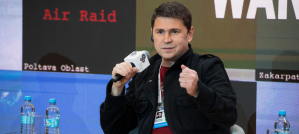

Victor Pinchuk Foundation and YES hosted a discussion ‘Survival: Bottom Line’ during the YES Special Gathering on February 24, 2026
On 24 February 2026, the Victor Pinchuk Foundation and Yalta European Strategy (YES) held a discussion ‘Survival: Bottom Line’ during the YES gathering on the occasion of the fourth anniversary of Russia’s full-scale invasion of Ukraine.
Participants of this panel discussed how secure military and financial support for Ukraine is, considering domestic political developments in the United States and across Europe.
Participants included Radosław Sikorski, Deputy Prime Minister and Minister of Foreign Affairs of the Republic of Poland; Kurt Volker, Distinguished Fellow, Center for European Policy Analysis; Chrystia Freeland, Former Deputy Prime Minister of Canada (2019–2024), Advisor to the President of Ukraine on Economic Development; and Viktorija Čmilytė-Nielsen, Deputy Speaker, Seimas.Moderator – Gideon Rachman, Columnist, Financial Times.
Opening the panel, Gideon Rachman, asked, is survival all that Ukraine can hope for? Is survival victory?
Kurt Volker, responded first, saying: “There is only one outcome that is possible. Ukraine survives as a sovereign, independent European democracy. A prosperous country with security guarantees. There is no other outcome here. Ukraine is not going to be defeated. Russia is not going to be victorious. That is more than survival – that is Ukraine thriving and prospering in the long run. The only issue is time. How much time do we let this go on? Can we accelerate that timeline so that Ukraine can really take off and Russia is contained in its ambitions.
“The way we can impact time is to really put pressure on Putin now, which we’re not doing. President Trump has done a lot of things, but the single ingredient that is missing is getting Russia to stop, and that requires serious pressure on the finances and the military.
“President Trump’s failure is that he listens to Putin, Putin says he wants peace, he wants to end the war, and that there is a deal to be made with Russia for billions of dollars, after the war has ended. Therefore, we see this extended war, peace negotiations going round in circles because Putin is not serious, and Ukrainians having to play the game so they are not blamed, at the same time knowing there is no real peace to be had.
“We have to keep pressing for President Trump to realise that he is being strung along by Putin. There is no pot of gold at the end of the rainbow. It is just a story.”
Radosław Sikorski brought the conference good news from the meeting of the Coalition of the Willing, saying: “The President of the EU Council and the President of the EU Commission both said that the decision on the €90bn loan for Ukraine, stands, will be executed and will be disbursed.”
He also commented on the current situation with the US approach, saying, “The current administration is trying to re-define the trans-Atlantic deal. Traditionally it was that they protect us from Russia, but we paid deference, particularly in security matters, and bought American weapons. Now they want to protect us less, and to pay less for it, but want us to pay more deference and buy more US weapons.
“I suspect President Trump thought if he did not do another supplemental package then Ukraine would find itself in difficulty much faster and the war would be ended because Ukraine would be forced into concessions. He will find that that while having European support Ukraine is not falling and therefore that the war cannot be ended without Ukrainian and EU agreement.
Europe is paying for the war 100%. Eventually, Putin will find he cannot end this war without Europe.”
Chrystia Freeland, asked whether, given that there is no pressure on Putin, the peace talks are premature, or whether they offer a solution or possible way out of the war, responded:
“Those of us who are not Ukrainian, those of us whose sons are not soon going to face a choice about whether they will sign up to fight, need to be quite humble when it comes to voicing views about how long Ukraine should fight. Sure democratic allies have supported Ukraine. It is easy to write a check than it is for your son, husband or brother to die. The question about whether/when Ukraine should end the war should be 100% in the purview of Ukrainians.”
Viktorija Čmilytė-Nielsen, Deputy Speaker, Seimas, speaking about the change in strategy needed to end the war, said, “The idea of ‘strategic patience’ has failed. Autocrats have all the time in the world to be strategically patient. Democratic cycles are frightfully quick. At some point there will be a pro-Russian government in one or two or three western States and that will become a big obstacle. Putin and Lukashenko have no time constraints. They play a game with no rules and no time constraints.”
Talking about the change in the US approach, she continued, “The world has changed, that is the reality. We as Europe have to shoulder more responsibility for our own security. We have to act on the reality. It is so important not to throw Russia a lifeline now, not to keep it afloat. But we see it clawing its way back, we see it in sport, at all sorts of other common tables, and it is not helped by the US admin. Sanctions, painful measures, do work – we have to continue with them. Ignoring the reality as Europe, and as the Eastern flank, would be very dangerous.”
The YES Special Gathering on February 24 is a platform for an honest conversation about the price of freedom, the limits of endurance, and shared responsibility for the future of Europe. Four years on from the full-scale invasion, Ukraine remains on the front lines not only of its independence, but also of the security of the entire democratic world.
Photos are available here
Video will be on YouTube www.youtube.com/user/PinchukFoundation
←Back to news list